The Introduction
In 2026, the internet is flooded with AI-generated noise. Every day, thousands of bots and “fake experts” post the same generic advice. For a founder, this creates a major challenge: How do you make people believe you are the real deal? The answer isn’t just posting more content—it’s learning how to build a trust moat for personal brand authority.
A “Trust Moat” is a protective barrier around your reputation made of undeniable, human-only proof. If you want to survive the AI wave and stand out, the most valuable skill you can master is to build a trust moat for personal brand longevity. This isn’t just about marketing; it’s about survival. In this guide, we’ll show you the 5 strategic steps to build a trust moat for personal brand success, turning your expertise into an unshakeable asset that no competitor—or AI—can copy.
What is a Trust Moat in 2026?
To understand how to build a trust moat for personal brand success, we first need to define it. In the past, a “business moat” meant having the lowest price or a secret patent. But in 2026, those things are easy to copy. Today, a Trust Moat is the emotional and logical barrier that protects your brand from being replaced by AI or cheaper competitors.
When you successfully build a trust moat for personal brand authority, you are creating a “Digital Fortress.” This fortress is built on Personal Brand Authenticity and Digital Trust. It is the reason why a customer will choose to pay you $\$5,000$ for a service when an AI bot offers it for free. They aren’t just buying the result; they are buying the Founder Authority and the human connection that only you provide.
The Key Elements of a 2026 Trust Moat
If you want to build a trust moat for personal brand longevity, your strategy must include these three LSI (Latent Semantic Indexing) elements:
- Proof of Transformation (Case Study Marketing): You don’t just tell people you are good; you show the “Before and After” of your work.
- Proof of Human Interaction: Showing that real people are talking to you, tagging you, and thanking you in real-time.
- AI-Proof Credibility: Sharing unique perspectives and personal stories that an AI model cannot invent.
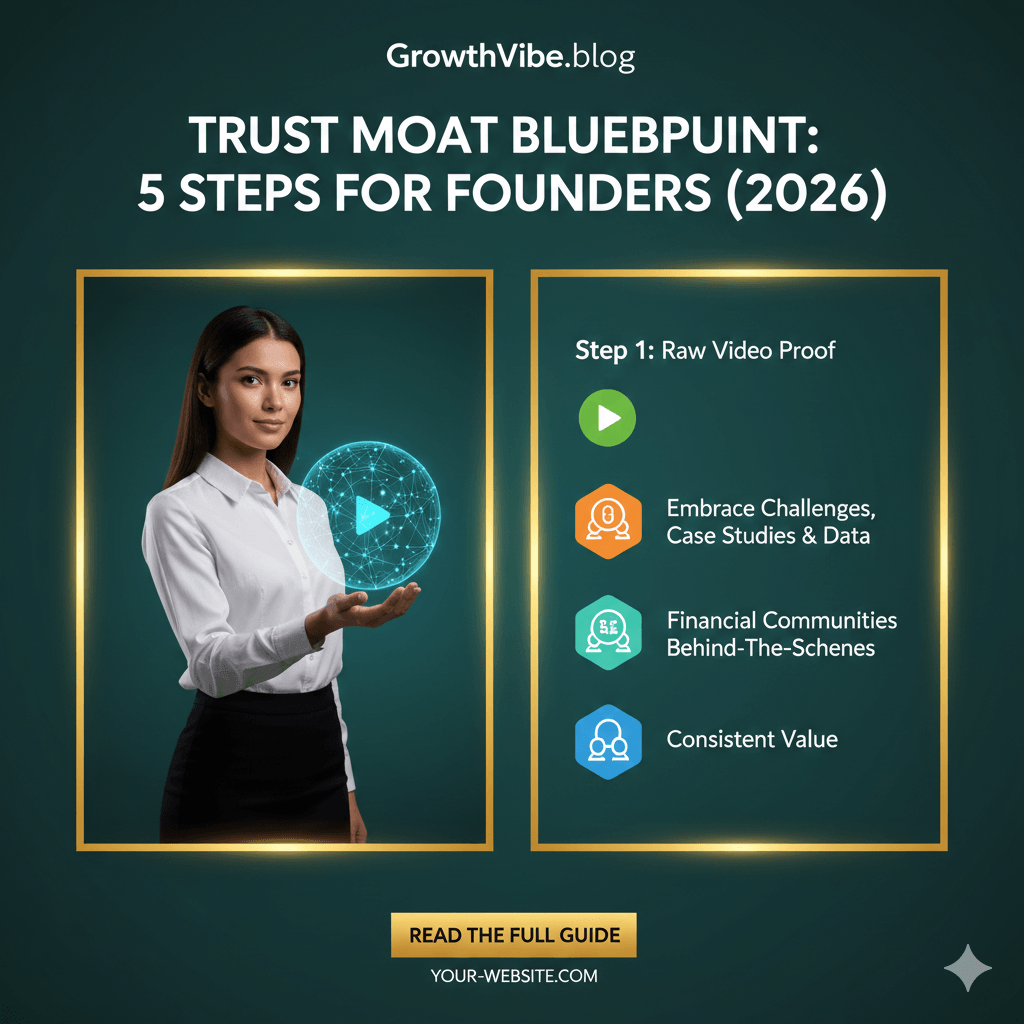
The 5 Strategic Steps to Build a Trust Moat for Personal Brand Success
To build a trust moat for personal brand longevity, you cannot rely on old marketing tricks. You need a system that proves your value every single day. Follow these five steps to secure your brand.
Step 1: Capture “Raw” Video Proof
In 2026, text reviews are easy to fake with AI. If you want to build a trust moat for personal brand authority, you need Video Testimonials.
- The Strategy: Ask your clients to record a 30-second video on their phone.
- Why it works: Raw, unedited video builds Digital Trust because it shows a real human talking about a real result. This is a key part of Social Proof 2026.
Step 2: Master “Proof of Work” Documentation
“To document your process without spending hours, you can use [Business Automation Tools for Founders] to capture your workflow automatically.”
Don’t just show the final product; show the mess. People trust founders who show their process.
- The Strategy: Share screenshots of your drafts, your late-night brainstorming sessions, and your “failed” attempts.
- Why it works: This builds Personal Brand Authenticity. When you show how you work, you build a trust moat for personal brand credibility that a “perfect” AI bot can never replicate.
Step 3: Create High-Depth Case Studies
Generic blog posts are dying. High-depth Case Study Marketing is the future.
- The Strategy: Write one “Master Case Study” every month. Include the exact problem, the exact steps you took, and the data-backed results.
- Why it works: Deep value increases your Avg. Engagement Time. When a visitor spends 5 minutes reading your case study, you are successfully learning how to build a trust moat for personal brand dominance.
Step 4: Leverage Third-Party Verification
“Building trust is just one part of the puzzle. You also need a solid [Personal Brand Strategy 2026] to dominate your niche.”
Your moat is stronger when other authorities talk about you.
- The Strategy: Get featured on podcasts, guest post on respected industry blogs, or use “Verified” badges from third-party review platforms.
- Why it works: This is called Founder Authority transfer. When an established brand trusts you, their audience trusts you too. It is a fast track to build a trust moat for personal brand growth.
Step 5: Build an “Engaged Small Circle”
You don’t need a million followers; you need 100 “True Fans” who defend your name.
- The Strategy: Focus on deep engagement in your comments and DMs. Host small, live Q&A sessions.
- Why it works: Community is the ultimate moat. When you have a group of people who publicly vouch for you, you build a trust moat for personal brand security that acts like a digital fortress.
Common Mistakes: What Destroys a Trust Moat in 2026?
Even if you know how to build a trust moat for personal brand success, one wrong move can make it crumble. In the digital age, losing trust is faster than building it. Avoid these “Moat Killers” to keep your Founder Authority intact.
1. Over-Filtering and Perfection
In 2026, “perfect” looks like AI. If your photos are too edited and your videos follow a robotic script, people will assume you aren’t real. Personal Brand Authenticity thrives on raw, unpolished moments. Don’t be afraid to show your workspace or talk about a project that didn’t go as planned.
2. Ghosting Your Community
You cannot build a trust moat for personal brand growth if you only post and never reply. Trust is a two-way street. If you ignore comments or DMs, you aren’t building a moat; you’re just building a billboard.
3. Relying on “Old” Social Proof
If your last testimonial is from 2022, it’s irrelevant. In 2026, people want to see what you are doing now. To successfully build a trust moat for personal brand longevity, you must refresh your Social Proof 2026 assets every quarter.
5. High-Value Habits to Maintain. Building trust never stops. Share new case studies every week to keep your results current and show your progress
Building trust is not a “one-time” event; it is a daily commitment. To build a trust moat for personal brand longevity, you must treat your credibility like a living asset that needs constant care. If your social proof is outdated, your moat will dry up.
Weekly Case Study Updates
The most important habit is to share new case studies every week. In the fast-moving world of Social Proof 2026, what worked last year is old news. By publishing weekly updates, you keep your results current and prove that your methods still work in today’s market.
- The Strategy: Set aside time every Friday to document one small win, one client breakthrough, or one data-backed result.
- Why it works: This creates a “Freshness Signal” for both Google and your audience. It shows that you are active and consistently producing Founder Authority through real-world action.
Consistent Value Proof
To build a trust moat for personal brand success, you must show your progress publicly. Don’t just post the finished product; share the journey of how you are improving your own skills.
- The Strategy: Use “Building in Public” tactics to show your learning curve, the new AI tools you are testing, and how you are staying ahead of the curve.
- Why it works: It builds Digital Trust because it shows you are a practitioner, not just a theorist. People trust experts who are constantly evolving.
Active Community Engagement
A trust moat is only as strong as the people defending it. You must make it a habit to engage deeply with your followers.
- The Strategy: Reply to every thoughtful comment with more value than the original post.
- Why it works: High-quality interaction is a form of Personal Brand Authenticity. It proves there is a real human behind the screen who cares about the community’s success. This is the ultimate way to build a trust moat for personal brand security against generic competitors.
Conclusion: Your Reputation is Your Only Moat
As we move further into 2026, the digital landscape will only become more crowded. Technology, algorithms, and AI tools will continue to change at a rapid pace. However, the human need for trust, connection, and proven results will remain constant.
The only way to ensure your business survives and thrives is to build a trust moat for personal brand authority. By consistently applying Social Proof 2026 strategies, capturing raw Video Testimonials, and sharing your journey through Personal Brand Authenticity, you are creating a competitive advantage that cannot be automated or stolen.
Remember, you don’t need a million followers to be successful. You need a “Trust Moat” so deep that your ideal clients wouldn’t dream of going anywhere else. Start building your fortress today—one testimonial, one case study, and one honest story at a time.
“As digital landscapes evolve, staying updated with [Google’s Search Essentials] is crucial for maintaining your brand’s visibility.” (Link to: https://developers.google.com/search/docs/essentials)
Final Call to Action (Engagement Booster)
What is your biggest challenge in building trust online? Whether it’s getting your first video review or documenting your process, I’d love to hear from you. Leave a comment below or share this guide with a fellow founder who needs to build a trust moat for personal brand success!