
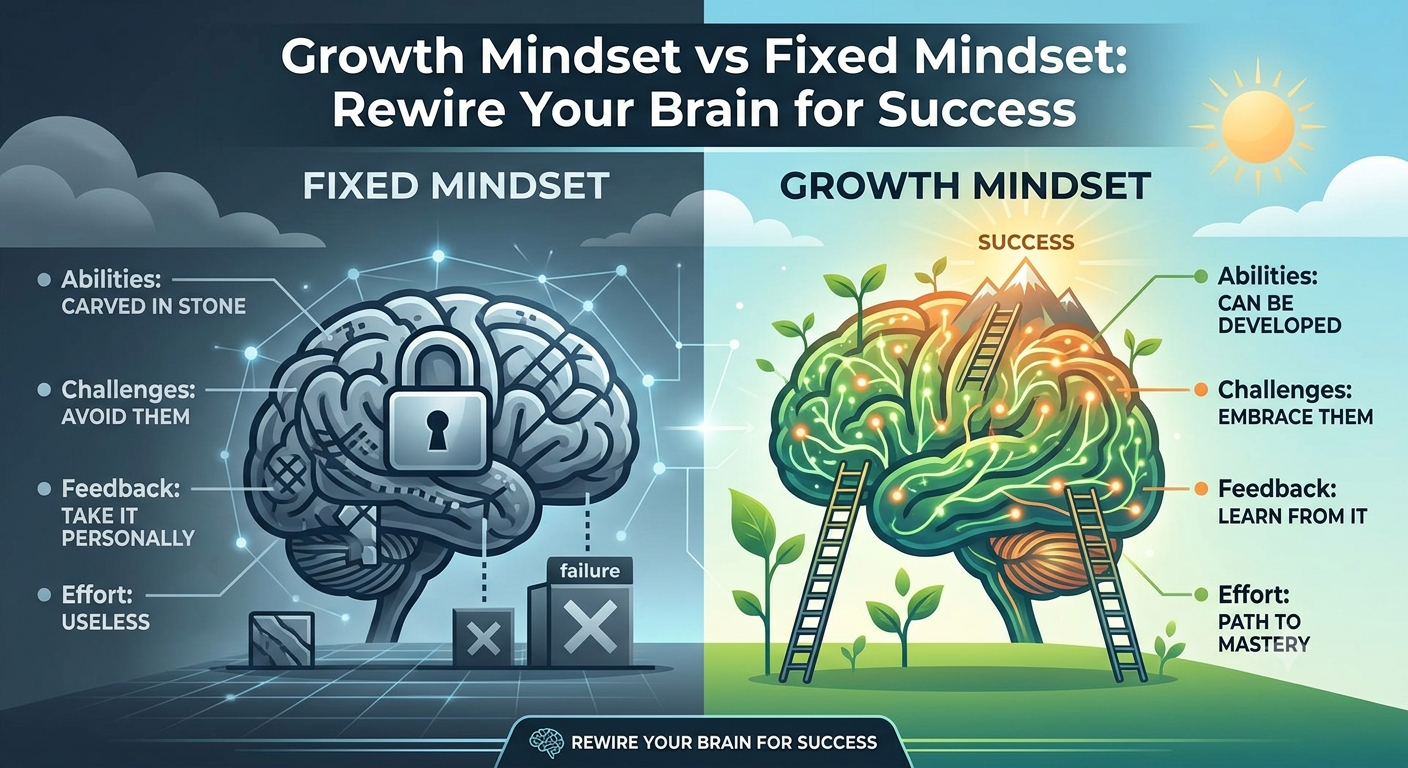
Success in 2026 depends on more than talent. Your mindset determines how you respond to challenges, setbacks, and opportunities. Understanding growth mindset vs fixed mindset helps you build resilience, improve performance, and create lasting success.
While technology changes rapidly, one advantage remains timeless. People who believe they can improve continue growing. Meanwhile, those who believe their abilities are fixed often stay stuck. Fortunately, modern psychology and neuroscience offer real insight into how the growth mindset vs fixed mindset divide forms — and how it can change.
Let’s explore what the research actually says, and how to apply it in daily life.
What Is Growth Mindset vs Fixed Mindset?
The concept was introduced by Stanford psychologist Carol Dweck in her 2006 book Mindset: The New Psychology of Success. In the growth mindset vs fixed mindset framework, a growth mindset is the belief that abilities can be developed through effort, learning, and persistence. A fixed mindset, by contrast, assumes that intelligence and talent are static traits that effort cannot meaningfully change.
Dweck’s original research found that students holding a growth mindset were more persistent when facing difficult problems and more willing to choose challenging goals over easy ones. These beliefs influence far more than academics — they shape how you handle criticism, solve problems, and pursue opportunities in business and daily life.
| Fixed Mindset | Growth Mindset |
|---|---|
| Avoids challenges | Welcomes challenges |
| Fears failure | Learns from failure |
| Gives up easily | Keeps improving |
| Rejects feedback | Uses feedback wisely |
| Feels threatened by success | Learns from successful people |
| Avoids difficult tasks | Embraces continuous learning |
Growth Mindset vs Fixed Mindset: What Does the Research Say?
It’s worth being honest here: growth mindset vs fixed mindset research is more nuanced than most blog posts admit.
A large meta-analysis of over 100 studies found that mindset beliefs are a measurable factor in how people regulate themselves toward goals. However, later re-analyses — including a widely cited 2020 study in Psychological Science — found that some of the original claims were overstated, and that effect sizes on academic test scores were smaller than first reported.
A major national experiment published in Nature by David Yeager, Carol Dweck, and colleagues found something more precise: growth mindset interventions do produce real, measurable benefits, but mainly under specific conditions — particularly for students who are already at risk of underperforming, and when the mindset shift is reinforced by a supportive environment rather than taught as an isolated lesson.
The practical takeaway from the growth mindset vs fixed mindset debate: mindset isn’t a magic switch that guarantees success. It’s one input, among many, that tends to help people persist longer, take more useful risks, and recover faster from setbacks — especially when it’s backed by real systems and habits, not just positive thinking.
Why the Growth Mindset vs Fixed Mindset Divide Matters for Entrepreneurs
Digital entrepreneurs face constant change. Algorithms evolve. Markets shift. Customer behavior changes.
A fixed mindset views these events as threats. A growth mindset treats them as feedback to act on.
Successful entrepreneurs usually:
- Adapt quickly
- Test new ideas
- Learn from failed campaigns
- Improve systems continuously
- Focus on progress instead of perfection
Consequently, they build businesses that remain competitive in changing markets — not because they never fail, but because they treat failure as information rather than identity.
[Hire Expert Digital Marketing Strategists on Fiverr] or [Find Professional Business Consultants on Fiverr]
Growth Mindset vs Fixed Mindset: 7 Practical Ways to Rewire Your Thinking
1. Add the Word “Yet”
Replace negative thoughts with possibility.
Instead of saying: “I can’t do this.”
Say: “I can’t do this yet.”
This simple shift encourages learning instead of quitting. It’s a small linguistic habit, but it directly reflects the belief structure Dweck’s research associates with persistence.
2. Welcome Constructive Feedback
Feedback helps you improve. Rather than taking criticism personally, ask:
- What can I learn?
- What should I improve?
- Which skill needs more practice?
Every improvement moves you closer to mastery.
3. Focus on Progress, Not Perfection
Perfection delays action. Instead, launch your project, gather feedback, and improve over time.
Small improvements compound into significant success.
4. Growth Mindset vs Fixed Mindset: Learn from Successful People
Instead of comparing yourself with others, study their strategies. Ask questions like:
- What habits helped them succeed?
- What systems do they follow?
- Which mistakes did they overcome?
Their journey becomes your learning blueprint.
5. Track Small Daily Wins
Celebrate every achievement, such as:
- Publishing an article
- Learning a new skill
- Finishing a difficult task
- Improving website performance
- Completing your daily goals
These small wins build confidence and motivation over time, reinforcing the belief that effort produces results.
6. Turn Problems into Opportunities
Every obstacle teaches something valuable. When something goes wrong:
- Identify the issue
- List possible solutions
- Test one solution
- Measure the results
- Improve continuously
This approach builds resilience over time — and matches the “supportive environment” condition researchers found makes mindset interventions actually work.
7. Build Positive Daily Habits
Your habits shape your mindset. Develop routines that encourage personal growth, such as:
- Reading daily
- Exercising regularly
- Journaling lessons learned
- Practicing gratitude
- Learning one new skill every week
Consistency always beats intensity.
Create an Environment That Supports a Growth Mindset
Your surroundings influence your thinking more than you realize. A productive workspace helps maintain focus and reduces distractions.
Consider these simple improvements:
- Keep your desk organized
- Write goals in a physical planner
- Limit unnecessary notifications
- Schedule uninterrupted deep-work sessions
- Review your weekly progress
A clean environment encourages clear thinking and better decision-making. As the Yeager and Dweck research suggests, environment and support systems matter just as much as individual belief in the growth mindset vs fixed mindset equation.
Common Signs You’re Stuck in a Fixed Mindset
You may be leaning toward a fixed mindset if you often think:
- “I’m not talented enough.”
- “I’m too old to learn.”
- “Failure means I’m not good enough.”
- “Successful people are simply lucky.”
- “I should already know this.”
Replace these thoughts with curiosity and action. Over time, your thinking shifts from fixed to growth-oriented, and it becomes more empowering.
Frequently Asked Questions
Can a Fixed Mindset Become a Growth Mindset?
“Yes — shifting from fixed mindset to growth mindset isn’t instant. Research suggests mindset shifts happen gradually through consistent learning, feedback, and supportive environments — not through belief alone.
How Does a Growth Mindset Improve Business Success?
It helps entrepreneurs adapt faster, solve problems creatively, and continue improving despite setbacks. It won’t replace skill or strategy, but it tends to extend how long someone persists before quitting.
How Long Does It Take to Develop a Growth Mindset?
There is no fixed timeline. Daily practice and real-world feedback create noticeable improvements over several weeks and months
Is Failure Necessary for Growth?
Failure is one of the most effective learning tools, provided it comes with reflection and adjustment — not just repetition.
Is growth mindset theory scientifically proven?
Partly. Some studies show meaningful effects, especially for at-risk learners and when paired with supportive environments. Other meta-analyses found the original claims were overstated. The honest answer is that mindset matters, but it’s not a standalone fix — it works best combined with real systems, feedback, and effort.
Final Thoughts on Growth Mindset vs Fixed Mindset
Understanding growth mindset vs fixed mindset is a genuinely useful lens for how you approach challenges — even though the science shows it’s not a magic bullet.
Success is rarely determined by natural talent alone. It comes from continuous learning, consistent action, and a willingness to treat setbacks as information rather than verdicts.
Choose progress over perfection. Learn from every challenge. Build habits and environments that reinforce your effort. Most importantly, remember that mindset works best as part of a system — not as a replacement for one.
Your mindset shapes how you respond to your future. Start rewiring your thinking today, and let every small, consistent step move you closer to lasting personal and professional success.