If you run a small business, chances are you’re stuck doing the same tiring tasks every single day:
- Answering Customer Emails: Handling the same repetitive support questions over and over instead of using automated engines or dedicated ai agents for small businesses.
- Manual Data Migrations: Copying customer details from one software tool into another entirely by hand without a smart connection.
- Fragmented Tech Stacks: Trying to make apps that don’t talk to each other actually work together manually rather than setting up streamlined agentic pipelines.
We’ve worked with dozens of small teams at GrowthVibe over the past year, and this is the single biggest thing slowing founders down. Not lack of ideas. Not lack of hustle. Just too much manual, repetitive work eating up the hours—which is exactly why integrating autonomous ai agents for small businesses has become so critical.
Here’s the good news: this year, that problem got a lot easier to solve. Deploying autonomous ai agents for small businesses — think of them as smart digital assistants that can actually think and act, not just chat — has made real automation possible for teams without a tech department.
Old chatbots could only follow a strict script. If a customer asked something outside that script, the bot got stuck. Today’s modern ai agents for small businesses are completely different. They understand what a customer actually wants, check your business data, connect to your other software through APIs (digital connectors between apps), and complete tasks on their own — without you sitting there watching every step.
Why AI Agents for Small Businesses Matter More Than Ever
When you’re running the show yourself, your biggest limit isn’t money. It’s your attention. You only have so many focused hours in a day.
That’s why business process automation (using software to handle repetitive tasks automatically) has stopped being a “nice to have” and become something founders genuinely need to survive in a competitive market.Setting up a comfortable workspace with the right tools, like an Ergonomic Office Desk Setup on Amazon
is just as important as setting up your software to maintain high energy levels throughout your workday.
When your tools don’t talk to each other, you end up doing the connecting work yourself — copying, checking, and fixing mistakes. Implementing smart ai agents for small businesses can take that frustrating work completely off your plate:
More Time for True Growth: Landing high-ticket clients, building your community brand, and thinking strategically — you reclaim the time to focus entirely on the stuff only you can do.
Fewer Broken Handoffs: Instead of manually updating five different tools every time something changes, specialized ai agents for small businesses can sync everything instantly across your stack.
Lower Overhead Costs: Invoicing, basic follow-up emails, and everyday administrative work can run quietly in the background without you ever touching them.
Fewer Costly Mistakes: Machines don’t get tired at 6 PM. Repetitive tasks done by a digital agent tend to be significantly more consistent than the same task done by a rushed human.
How AI Agents for Small Businesses Actually Work (In Plain Terms)
There’s a real difference between basic automation and true agentic workflows, and it’s worth understanding before you invest your time or money.
- Basic Automation (tools like Zapier or Make.com): This infrastructure works on simple “if this happens, then do that” linear rules. For example: someone fills out a website form, so their info gets copied into a spreadsheet. It’s highly useful, but it can only follow the exact rule you set. Anything unexpected, and the system breaks or does nothing.
- True AI Agents (tools like Lindy or Relevance AI): These systems run directly on advanced large language models. Deploying these intelligent ai agents for small businesses means they can actually reason through a situation instead of just following a fixed, rigid rule.
Say a customer emails you, upset about a late package delivery. Instead of failing, an AI agent can read the emotional tone of the email, check your live shipping API data, look at that specific customer’s purchase history, and respond appropriately with a personalized resolution — all without you writing a single line of code or setting up rules for that exact scenario.
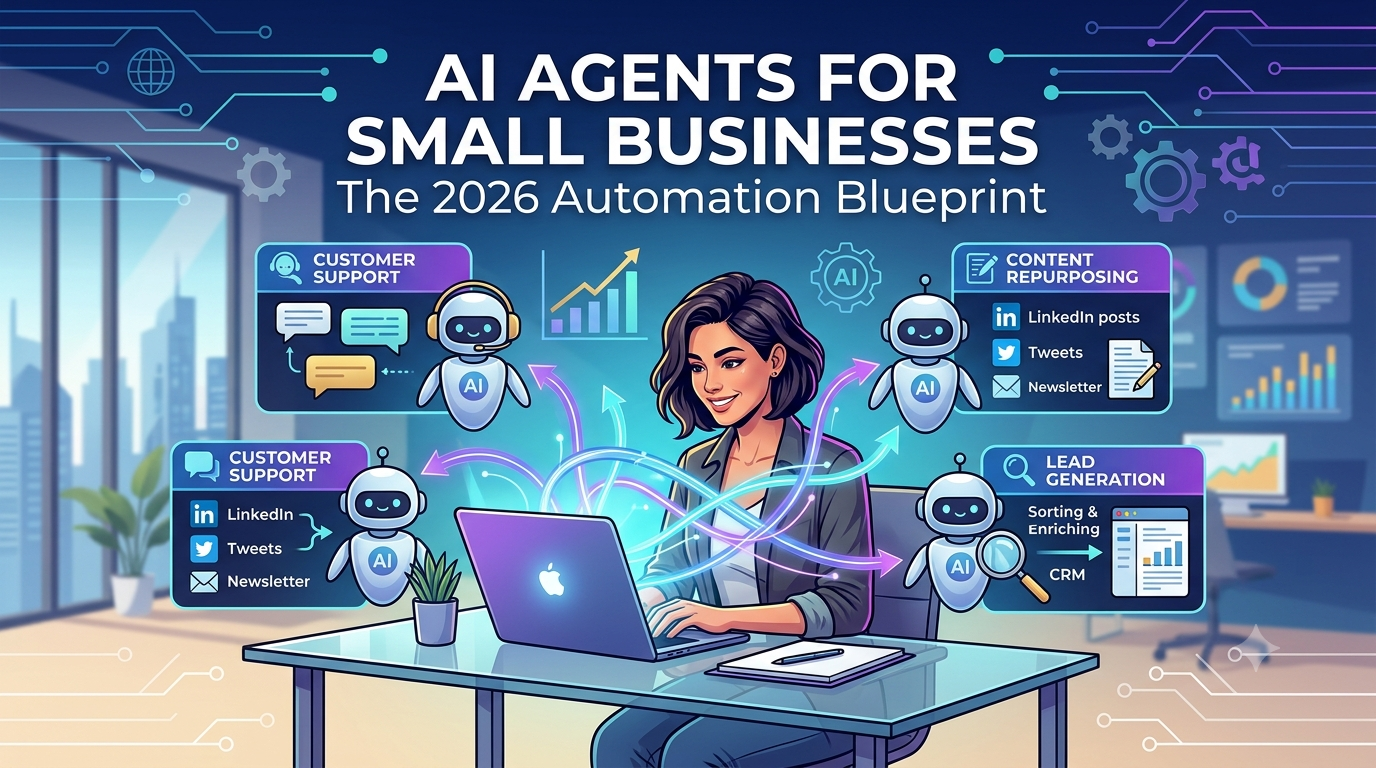
3 Things AI Agents for Small Business Owners Can Automate This Week
You don’t need to overhaul your entire business at once. Start with the tasks that eat the most time.
1. Customer Support and Inbox Management
A messy inbox is one of the biggest time drains for any small business owner. This is usually the first place an AI agent for small business support earns its keep — a well-set-up agent, trained on your FAQs and knowledge base, can handle the majority of routine customer questions on its own, any time of day.
If setting up the technical side (API connections, prompts, guardrails) feels like too much, it’s completely reasonable to hire specialized help. You can easily find vetted experts to build these custom pipelines for you by browsing Top AI Automation Specialists on Fiverr. You don’t need to become an engineer to benefit from this technology.
2. Repurposing and Sharing Your Content
If you create content, you already know how much time it takes to reformat one blog post or video into five different versions for five different platforms.
AI agents can now handle most of that:
- Breaking content down — taking one long blog post or video script and pulling out the key points automatically
- Reformatting for each platform — turning those points into a LinkedIn post, a Twitter/X thread, a newsletter, or a short-form video script
- Keeping your voice consistent — matching your existing tone and style so it still sounds like you, not a generic AI
3. Finding and Qualifying Leads
Manually researching prospects and sending generic cold emails doesn’t really work anymore — people can tell. If you want a steady stream of good-fit leads, an automated system can do the heavy research for you.
Tools like Clay, for example, can automatically look up what software a company already uses, pull recent news or LinkedIn activity about them, and use that context to write a personalized opening line — then drop it straight into your CRM, ranked by how good a fit that lead actually is.
How to Set Up Your First AI Agent for Small Business Use (No Coding Needed)
You don’t need a big budget or a developer to get started. Here’s a simple, four-step process:
Step 1: Pick one small, specific task (about 1–2 hours of planning)
Don’t try to automate everything at once. Choose one repetitive job — like “sorting incoming inquiry emails and logging them in my CRM.” A narrow starting point is much easier to get right.
Step 2: Give it clean, organized information
Your agent is only as good as what you feed it. Upload your pricing sheet, service terms, brand guidelines, and a few examples of emails you’ve written well in the past.
Step 3: Set clear boundaries
Decide exactly what the agent is allowed to do on its own, and what needs your approval first — especially anything involving money, sensitive data, or upset customers. Set up a way for it to hand off to you when it hits something it can’t handle.
Step 4: Test it before going live
Run 15–20 test scenarios to see how it handles different situations. Once you’re confident it’s making good decisions consistently, connect it to your real customer channels — and check in on its performance regularly, at least for the first few weeks.
(If you lack the time to go through these technical configurations yourself, consider outsourcing the setup phase to Expert No-Code Developers on Fiverr to ensure your data stays secure and accurate).
The Bottom Line
The businesses that do well in 2026 won’t be the ones working the longest hours. They’ll be the ones who built systems that work even when they’re not actively watching them. Deploying autonomous ai agents for small businesses lets a one- or two-person operation run with the absolute efficiency of a much bigger team, without the bigger overhead.
Which task would you hand off to an AI agent first? Let us know in the comments below — and if you get stuck setting up any custom ai agents for small businesses, the GrowthVibe community is always the perfect place to ask for technical help and troubleshooting.
If you want to compare specific software setups before choosing one, we’ve also put together a strategic breakdown of the top AI automation platforms for 2026, including Zapier AI, Make, and n8n to help you find the right engine.
Frequently Asked Questions (FAQs)
Q1: What is the main difference between simple automation and AI agents for small businesses?
Ans: Simple automation tools (like basic Zapier or Make.com recipes) operate strictly on rigid, linear “If This, Then That” (IFTTT) rules. They cannot handle context or unexpected changes. On the other hand, ai agents for small businesses run directly on advanced Large Language Models (LLMs). This allows them to actively reason through ambiguous data, interpret human emotions, and solve complex, unstructured problems without breaking the workflow.
Q2: Do I need coding skills to deploy AI agents in my business?
Ans: No, you do not need an enterprise IT budget or advanced programming skills to get started. Modern agentic platforms like Lindy, Relevance AI, and parts of Zapier AI are built with highly intuitive, no-code interfaces. You can easily connect your software stacks via visual APIs and write operational guardrails using plain English prompts.
Q3: What business processes should I automate first?
Ans: It is highly recommended to start with a single, narrow, and highly repetitive objective. Focus on the three biggest operational bottlenecks:
- Customer Support & Inbox Management: Automating routine query sorting and knowledge-base ticketing.
- Content Distribution: Repurposing one long-form post into multi-channel social formats.
- Lead Prospecting: Automating data scraping, tech-stack identification, and CRM logging.
Q4: Can AI agents integrate with my existing CRM and software tools?
Ans: Yes. Next-generation ai agents for small businesses connect seamlessly with your modern tech stack (including Google Sheets, CRMs, Slack, and email providers) using standard webhooks and API connectors. This completely eliminates manual data entry and prevents fragmented data silos across your tools.
Q5: How do I ensure an AI agent doesn’t make critical mistakes with my clients?
Ans: You can protect your workflow by establishing strict operational guardrails and safety logic. When setting up your agent, explicitly program its permissions, outline which high-friction actions require direct human approval, and configure a “warm handoff” logic that routes complex or escalated customer responses to a human operator instantly.