In the rapidly evolving digital landscape, simply using AI tools is no longer a competitive advantage—it is the bare minimum. To truly lead in the new economy, you must move beyond manual prompting and master a seamless AI Automation Workflow. By 2026, wealth is being generated by those who can build “digital machines” that work while they sleep.
The gap between struggling freelancers and high-earning architects lies in their ability to orchestrate autonomous agents. At GrowthVibe, we believe that understanding a structured AI Automation Workflow is the ultimate shortcut to scaling your productivity and income. In this guide, we will break down the exact steps to connect your tech stack, eliminate repetitive tasks, and build a self-running business engine that ensures you stay ahead of the curve.
1. The Anatomy of a High-Performance AI Automation Workflow
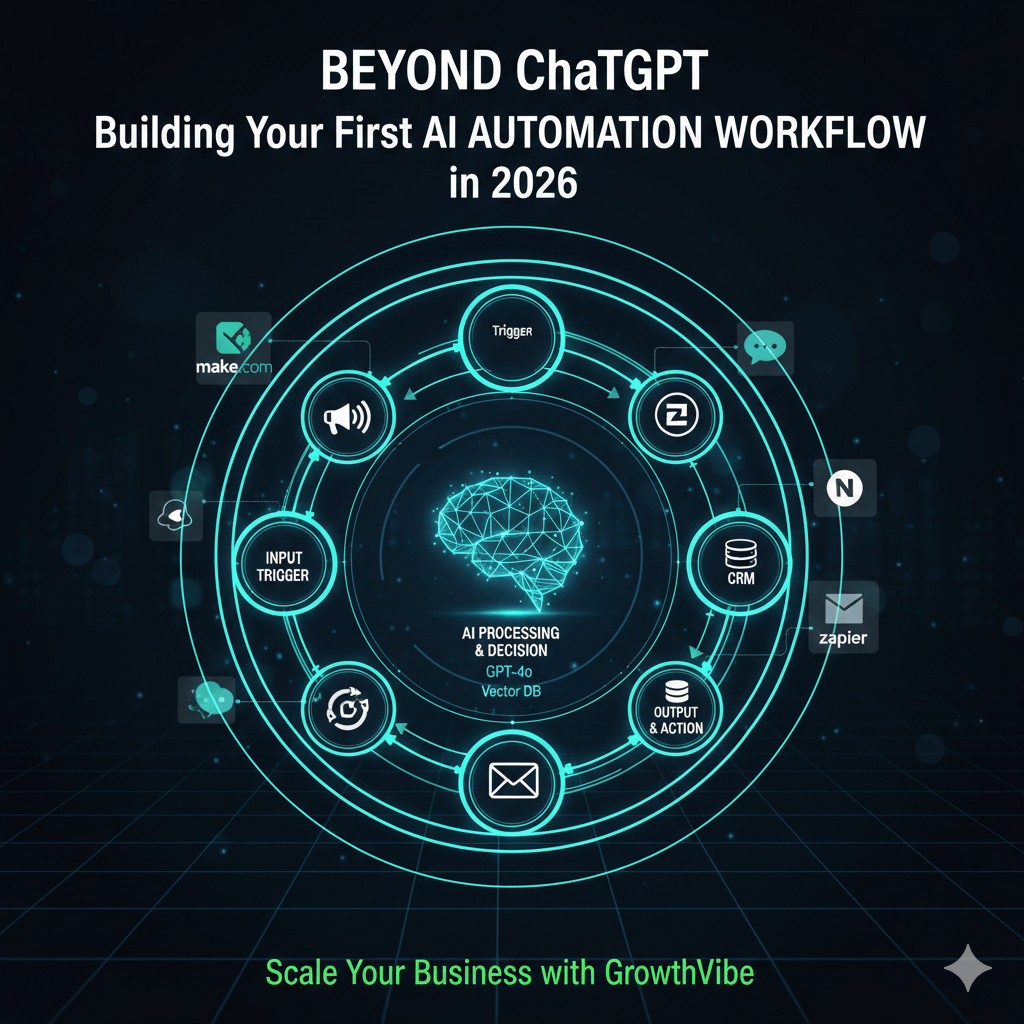
To build a system that works, you must first understand the “Trigger-Action” logic that governs modern automation. An AI Automation Workflow is essentially a digital assembly line where data flows from one tool to another without human intervention.
- The Trigger: Every workflow starts with an event (e.g., a new lead fills out a form, a price drop in crypto, or a mentions alert on social media).
- The Intelligence Layer: This is where the AI (like GPT-4o or Claude 3.5) processes the data, summarizes it, or makes a decision.
- The Action: The final output (e.g., sending a personalized email, updating a CRM, or posting a scheduled tweet).
Why Static Workflows are Dying
In 2025, workflows were rigid. In 2026, the AI Automation Workflow is dynamic. It uses “Conditional Logic,” meaning the AI can decide not to send an email if it detects the lead is already a customer, or it can escalate a support ticket if it senses “High Frustration” in the text.
2. Selecting Your Stack for AI Automation Workflow Mastery
You cannot build a 2026 business on 2020 tools. To master your AI Automation Workflow, you need a stack that supports API Connectivity and Autonomous Agents.
Essential Tools for 2026:
- Orchestration Platforms: Make.com (more visual/complex) and Zapier Central (easier for AI agent integration).
- The Brain: OpenAI API or Anthropic API keys. Using the API is 10x cheaper and more powerful than the web-based ChatGPT interface.
- Vector Databases: Pinecone or Airtable (with AI fields) to give your automation “Memory.”
- Communication Layers: Slack, Discord, or WhatsApp Business API for real-time notifications from your AI agents.
GrowthVibe Tip: Start with Make.com. Its visual “bubble” interface allows you to see the data path of your AI Automation Workflow in real-time. However, if you want to skip the technical learning curve, you can Register on Fiverr & Hire Top AI Automation Experts right now to build and deploy your autonomous systems in less than 24 hours.
3. Step-by-Step: Designing Your First Autonomous System
Let’s build a practical AI Automation Workflow for “Content Research & Distribution.” This is a high-value system that usually takes humans 10 hours a week, but your system will do it in 10 seconds.
Phase 1: The Input Trigger
Set up an RSS feed or a Google Alert for your niche keywords. When a new trending article is published, it triggers the workflow.
Phase 2: The AI Analysis
The data is sent to an AI agent. The agent is programmed to:
- Summarize the key points.
- Extract 5 “Viral Hooks” for LinkedIn.
- Check the facts against your private “Memory” database.
Phase 3: The Output Action
The summarized content is automatically sent to your Notion dashboard for approval. Once you click “Approve,” another AI Automation Workflow posts it to your social channels.
4. Overcoming the “Implementation Gap” in Business Automation
Many professionals fail because they try to automate everything at once. A successful AI Automation Workflow is built “Brick by Brick.”
- Solve the Bottleneck First: Don’t automate your filing system if your real problem is Lead Generation.
- Human-in-the-Loop (HITL): In 2026, the most reliable systems still have a “Human Checkpoint.” Use AI to do 90% of the work, but keep the final 10% for your human touch.
- Error Handling: Always build a “Router” in your AI Automation Workflow that sends you a Slack message if an API fails.
💡 Recommended Resource: If you want to master the exact business scaling frameworks used by elite founders, you can get the ultimateAutomation & Entrepreneurship Books on Amazon to start upgrading your business infrastructure today.
5. Scalability: From One Workflow to a Digital Workforce
Once you have mastered one AI Automation Workflow, you can duplicate it across different departments. This is how you achieve “Digital Scaling.”
The Multi-Agent Approach
In 2026, we don’t just use one AI; we use a team of specialized agents.
- Agent A (The Researcher): Scrapes the web for data.
- Agent B (The Analyst): Interprets the data and finds trends.
- Agent C (The Creator): Writes the final reports or copy.
Linking these agents through a central AI Automation Workflow creates a “Digital Department” that costs pennies to run but generates thousands in value.
6. The Future of AI Automation Workflow: Zero-Touch Operations
As we look deeper into 2026, the goal is “Zero-Touch Operations.” This is where the system monitors itself, fixes its own bugs, and optimizes its own prompts.
- Self-Correcting Loops: Advanced workflows now check their own output quality before sending it to a client.
- Dynamic Resource Allocation: If one AI model is slow or expensive, the AI Automation Workflow automatically switches to a cheaper model (like Llama 3 or Gemini Flash).
Why this is a High-Income Skill
Businesses are willing to pay $5,000 to $20,000 for a custom-built AI Automation Workflow because it saves them hundreds of thousands in labor costs. By mastering this, you aren’t just a “tech guy”—you are a Revenue Architect.
Conclusion: Take Action with GrowthVibe
“If you want to build a powerful presence alongside automation, check out my guide on Personal Branding Strategy.”
The era of clicking buttons manually is ending. Building your first AI Automation Workflow is the single best investment you can make in your professional career this year. It gives you back your time, multiplies your output, and creates a “Wealth Engine” that is independent of your physical presence.
Your Next Step: Pick one repetitive task today. Whether it’s sorting emails or generating weekly reports, find a way to turn it into an AI Automation Workflow.
Join the GrowthVibe Movement: “Master the machine before the machine masters the market. Subscribe for our exclusive ‘Workflow Templates’ and join a community of high-income architects.”