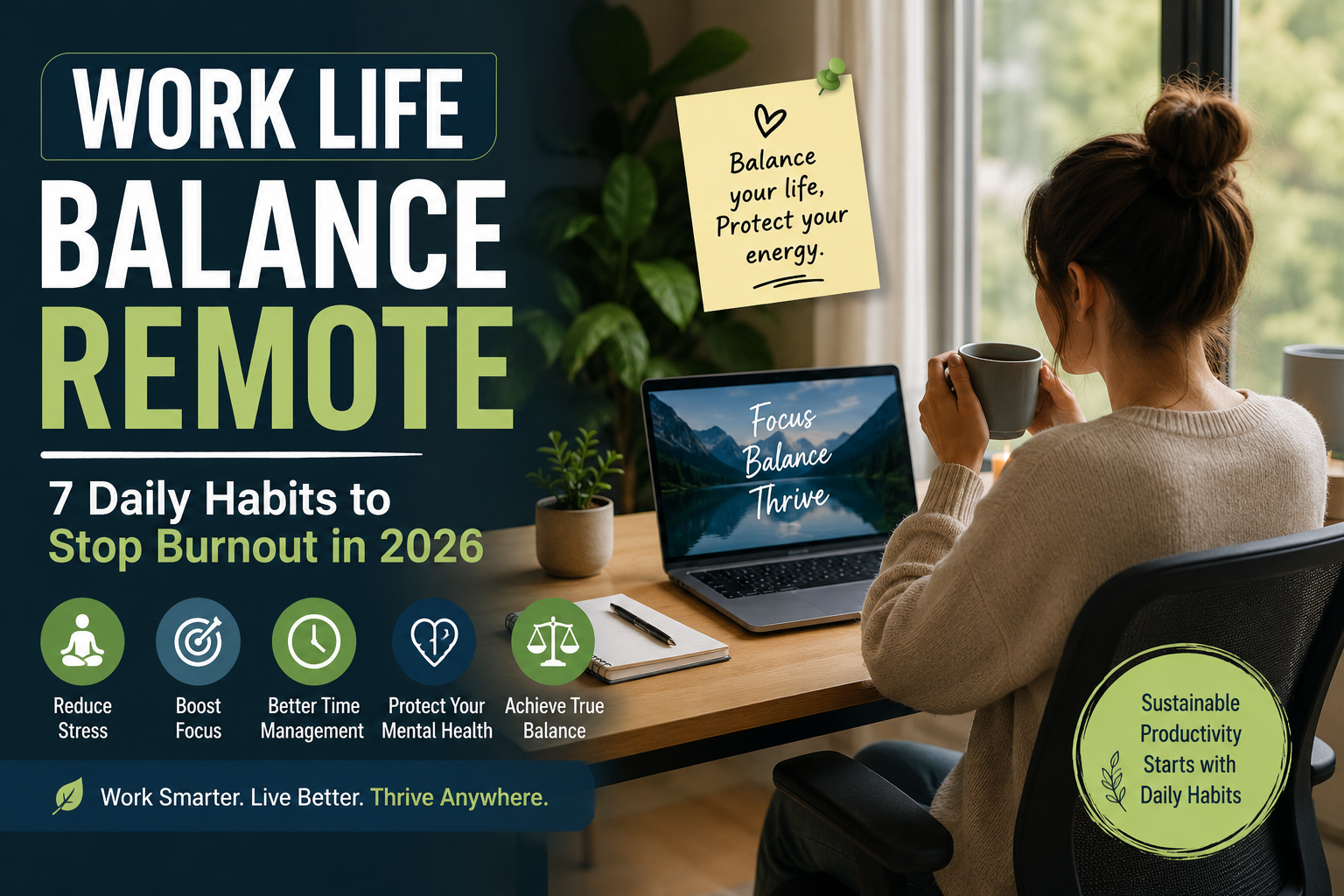
“Mastering a work life balance remote routine is the ultimate key to sustainable productivity in 2026. While the freedom of working from anywhere is one of the greatest perks of the modern digital era, without proper boundaries, achieving a healthy work life balance remote setup can quickly transform into a 24/7 cycle of stress, cognitive overload, and severe burnout.
By 2026, remote work burnout has officially become one of the leading causes of productivity drops, mental fatigue, and high turnover among digital professionals, freelancers, agency owners, and founders. The secret to maintaining a successful work life balance remote lifestyle long-term isn’t working fewer hours or sacrificing your career goals—it is establishing structured, science-backed daily habits that protect your mental bandwidth while maximizing your output.”
In this comprehensive guide, we unpack 7 proven daily habits to help you master work life balance remote strategies, reclaim control over your calendar, and eliminate burnout for good.
Quick Takeaway (TL;DR): Maintaining a work life balance remote setup stems from eliminating blurred boundaries, constant digital connectivity, and lack of structured recovery. By adopting intentional transitions, enforcing strict shutdown rituals, utilizing ultradian focus cycles, and batching low-value tasks, remote workers can protect their mental health without sacrificing career momentum.
💡 Recommended Ergonomic Desk Gear: Upgrading to an adjustable standing desk, an ergonomic mesh chair, or a dual-monitor arm can significantly reduce physical fatigue and posture strain during long work sessions. Check out top-rated ergonomic workstation setups on Amazon here.
The Modern Remote Work Dilemma: Why Burnout Peaks in 2026
“When the global transition toward remote work accelerated, workers celebrated the loss of long daily commutes, rigid dress codes, and artificial office presence. However, without a structured framework for work life balance remote teams, asynchronous tools, AI-assisted workflows, and always-on communication platforms expanded, causing the line between home life and professional responsibilities to virtually vanish.
Recent workplace psychological studies reveal that remote employees work an average of 2.5 additional hours per day compared to their in-office counterparts. This extra time rarely translates to higher quality output; instead, without strict work life balance remote boundaries, it often leads to perpetual task-switching, continuous micro-notifications, and elevated cortisol levels.”
1. The Invisible Workplace Syndrome
In a physical office, packing your bag and leaving the building provides a clear behavioral anchor that tells your brain work is over. At home, your laptop rests just meters away from where you relax or sleep. This proximity generates “The Invisible Workplace Syndrome”—a constant feeling that you should be checking emails, resolving Slack notifications, or completing one extra task.
2. The Frictionless Hyper-Connectivity Trap
Modern remote stacks feature instant messaging, automated project boards, and real-time document collaboration. While these tools drive efficiency, they also construct a culture of immediate urgency. Without strict personal protocols, remote workers spend their days reacting to inbound requests rather than engaging in high-value, deep work.
Habit 1: Create a “Fake Commute” to Anchor Your Workday
In a traditional 9-to-5 setup, the physical commute serves a vital psychological function: it acts as a mental buffer transition between your personal identity and your professional responsibilities. When you manage a work life balance remote daily schedule, jumping straight from your bed to your laptop screen scrambles your brain’s natural transition signals.
Establishing a structured 15-to-20-minute “fake commute” every morning creates a deliberate barrier between waking up and entering deep work mode.
How to Execute a Daily Fake Commute:
- Outdoor Morning Walk: Spend 15 minutes walking around your local neighborhood or park. Exposure to early morning sunlight resets your circadian rhythm, boosts natural dopamine, and sharpens alertness.
- Mindful Beverage Ritual: Sit quietly on a porch, balcony, or designated lounge chair with a fresh coffee or tea for 15 minutes. Crucially, do not check email or scroll social media during this time.
- Active Physical Stretch: Complete a dedicated 15-minute mobility routine or light yoga practice focused on opening your hip flexors and chest before sitting down at your desk.
This habit signals to your nervous system that the workday is officially beginning, triggering mental focus without over-relying on acute stress responses or excess caffeine.
Habit 2: Set Strict “Digital Shutdown” Hours
The single greatest driver of chronic remote work burnout is constant digital availability. Checking Slack messages or answering client emails at 10:00 PM creates continuous, low-level mental anxiety that prevents true physiological recovery.
To establish psychological safety and sustain a healthy work life balance remote lifestyle, you must define a non-negotiable hard cutoff time for your workday (e.g., 6:00 PM) and implement a systematic closing sequence.
The 4-Step Digital Shutdown Ritual:
- Review & Clear Open Loops: Spend the final 10 minutes of your day checking your task list. Move uncompleted items to tomorrow’s schedule so your brain doesn’t try to track them overnight.
- Close Work Applications: Close all project-related browser tabs, exit communication channels, and shut down heavy work applications.
- Automate Availability Status: Set your Slack or Teams status to “Offline” or “Away” and configure automatic Do Not Disturb (DND) modes on your mobile devices.
- Physical Workstation Exit: Push in your chair, turn off your desk lighting, and physically leave your workspace. Treat your shutdown time with the same level of respect you would give a high-stakes client presentation.
🚀 Automate Your Business Workflows: Reduce your daily manual operational workload by setting up automated lead funnels, marketing sequences, and client workflows using Systeme.io. Let smart automation handle repetitive tasks while you enjoy guilt-free evening downtime. Explore Systeme.io automation tools here.
Habit 3: Implement the 50/10 Focus & Recovery Cycle
“Human attention operates in ultradian rhythms—naturally occurring cycles of high cognitive performance lasting roughly 90 to 120 minutes, followed by a mandatory recovery trough. Attempting to sit in front of a screen continuously for three or four hours without breaks leads directly to diminishing returns, frequent errors, and intense mental exhaustion, making work life balance remote efforts almost impossible.
Adopting a structured 50/10 Focus & Recovery Cycle allows you to align your daily workload with your natural biology while sustaining long-term work life balance remote productivity.”
Optimizing the 50/10 Sprint Cycle:
For 50 minutes, work with undivided, single-task focus. Turn off phone alerts, close unnecessary browser windows, and dedicate your attention strictly to one primary objective. Once the 50-minute timer alerts you, immediately transition into a 10-minute complete recovery phase.
| During the 50-Minute Sprint | During the 10-Minute Recovery |
|---|---|
| Single-task focus on key deliverable | Step away completely from all screens |
| Notifications and messaging muted | Hydrate with cold water or electrolytes |
| Time tracking enabled for accountability | Perform light stretching or breathwork |
By enforcing off-screen breaks every hour, you keep your nervous system calm and preserve energy for late-afternoon tasks.
Habit 4: Designate a Dedicated, Clean Workzone
“Working from your bed or living room sofa blurs the essential psychological boundary between relaxation and effort. Your brain uses environmental cues to regulate neurochemistry; when you attempt to perform high-level strategy in bed, your brain struggles to determine whether it should be releasing focus hormones or sleep hormones, directly impairing your work life balance remote routine.”
Establishing a designated, clutter-free workzone conditions your mind to instantly recognize when it is time to produce and when it is time to rest, which is foundational to a successful work life balance remote workflow.
Key Elements of an Optimal Workzone:
- Spatial Isolation: Carve out a distinct area strictly reserved for work. If you do not have a separate home office, dedicate a specific desk or table corner exclusively to professional activities.
- Visual Cleanliness: Keep the surface clear of personal mess, dishes, or unrelated paperwork. Visual clutter causes micro-distractions that degrade focus capacity over time.
- Ergonomic Support: Ensure your desk height, monitor level, and seating posture maintain alignment, protecting your spine and neck from long-term strain.
When you physically step away from this designated workspace at the end of your day, your work-related thoughts stay behind at your desk.
🛠️ Delegate Repetitive Workloads: Don’t try to manage every minor administrative or technical task yourself. Scale your daily output and free up precious mental energy by hiring verified freelance virtual assistants, data entry experts, or graphic designers on Fiverr. Find qualified freelance talent on Fiverr today.
Habit 5: Batch Low-Value Tasks and Communication
“Context switching—the constant bouncing between writing reports, responding to incoming Slack messages, checking email, and editing spreadsheets—wastes tremendous mental energy. Studies show that it takes an average of 23 minutes to regain deep focus after a single minor interruption, which quickly destroys a functional work life balance remote schedule.
Batching your communication and low-value administrative tasks into specific, contained time windows protects your most productive hours for high-impact visual or strategic execution, strengthening your work life balance remote boundaries.”
Implementing Communication Batch Windows:
Instead of keeping your inbox open all day, select two dedicated time blocks to process all incoming communication (e.g., 11:30 AM and 4:30 PM).
- Morning Focus Block (9:00 AM – 11:30 AM): Dedicate your prime morning cognitive energy exclusively to high-priority creative or analytical projects.
- First Communication Window (11:30 AM – 12:00 PM): Process emails, update team boards, and reply to urgent messages.
- Afternoon Execution Block (1:00 PM – 4:30 PM): Focus on secondary tasks, meetings, and operational execution.
- Final Communication Window (4:30 PM – 5:00 PM): Clear remaining communications and prepare your agenda for the following day.
Habit 6: Fuel Your Brain with Mid-Day Movement
Physical stillness causes mental stagnation. Sitting in a chair for 8 to 10 hours straight reduces blood flow to the brain, leading to the infamous “3:00 PM slump” where focus drops and lethargy sets in.
Incorporating 20 to 30 minutes of intentional physical movement during your mid-day break revitalizes your circulatory system, lowers stress hormones, and improves mood for the remainder of the afternoon.
Effective Mid-Day Movement Options:
- Brisk Neighborhood Walk: A fast-paced 20-minute outdoor walk supplies oxygen to the brain while providing a complete mental rest from screen light.
- Bodyweight or Resistance Training: A concise home workout using kettlebells, resistance bands, or bodyweight exercises (push-ups, air squats, lunges) raises your heart rate and sharpens alertness.
- Postural & Mobility Flow: Focused mobility exercises targeting hip flexors, hamstrings, upper back, and shoulders counteract the physical compression caused by prolonged sitting.
Habit 7: Audit Your Time Weekly and Adjust Boundaries
Maintaining a healthy work life balance remote setup is an ongoing process of tuning and adjustment, not a single setup step. A schedule that works during a quiet week might crumble during a major product launch or client onboarding phase.
At the end of every week, dedicate 10 minutes to review your calendar and reflect on your operational habits using a weekly self-audit framework.
The Weekly 3-Question Self-Audit Framework:
- Where did my time bleed unnecessarily this week? (e.g., unexpected low-value meetings, endless messaging threads, lack of daily task priorities).
- Which habit provided the greatest mental energy and focus? (e.g., strict adherence to the 6:00 PM digital shutdown, morning outdoor walks).
- What single boundary must I enforce more firmly next week? (e.g., declining unscheduled call requests, closing email during deep-work sprints).
Summary: The Remote Work Balance Blueprint
To help you implement these 7 daily habits smoothly into your work routine, review this quick summary matrix:
| Habit | Core Action | Primary Benefit |
|---|---|---|
| 1. Fake Commute | 15–20 min outdoor walk or stretch before starting work | Smooth psychological transition into focus mode |
| 2. Digital Shutdown | Strict cutoff time with automated notifications muted | Prevents burnout and protects personal time |
| 3. 50/10 Focus Cycles | 50m deep work sprint + 10m off-screen break | Sustains energy levels and reduces cognitive fatigue |
| 4. Dedicated Workzone | Work strictly at a clean, organized desk workspace | Trains brain to separate work from rest areas |
| 5. Task Batching | Process emails and messages twice daily max | Protects creative hours and eliminates context switching |
| 6. Mid-Day Movement | 20–30 min walk, workout, or yoga break | Boosts blood flow and overcomes the afternoon slump |
| 7. Weekly Time Audit | 10 min Friday review of schedule and boundaries | Ensures continuous adjustment of daily routines |
Frequently Asked Questions (FAQs)
How do I manage client expectations when enforcing digital shutdown hours?
Clear communication is essential. Set explicit response SLAs (Service Level Agreements) in your client onboarding materials or email signatures (e.g., “Our team responds to inquiries between 9 AM and 5 PM EST, Monday through Friday”). When clients know when to expect your response, emergency requests decrease dramatically.
What if I don’t have enough space in my apartment for a dedicated home office desk?
If spatial limitations prevent a dedicated room, establish environmental visual cues. Use a specific desk mat or lamp that you turn on only during work hours. When your workday ends, pack your laptop and mat away inside a drawer out of sight to create a mental break.
Is the 50/10 focus cycle better than the standard 25-minute Pomodoro Technique?
For complex creative, strategic, or technical tasks (such as writing, coding, or planning), 25 minutes is often too short to reach deep flow states. The 50/10 cycle provides a longer period for focused execution while guaranteeing meaningful recovery time every hour.
Final Thoughts for Remote Founders & Freelancers
Achieving a long-term, sustainable work life balance remote lifestyle is not about working less; it is about working intentionally. By embedding these 7 structured daily habits into your workflow and taking advantage of smart workflow automation and talent delegation tools, you can build a highly productive, sustainable remote routine in 2026.
GrowthVibe Action Step: Select just TWO habits from this list to implement starting tomorrow morning. Once those routines feel natural, introduce the remaining habits step-by-step to build a resilient daily schedule!
Affiliate Disclosure: This post contains affiliate links for tools and products we recommend. If you make a purchase through these links, GrowthVibe may earn a small commission at no additional cost to you.