
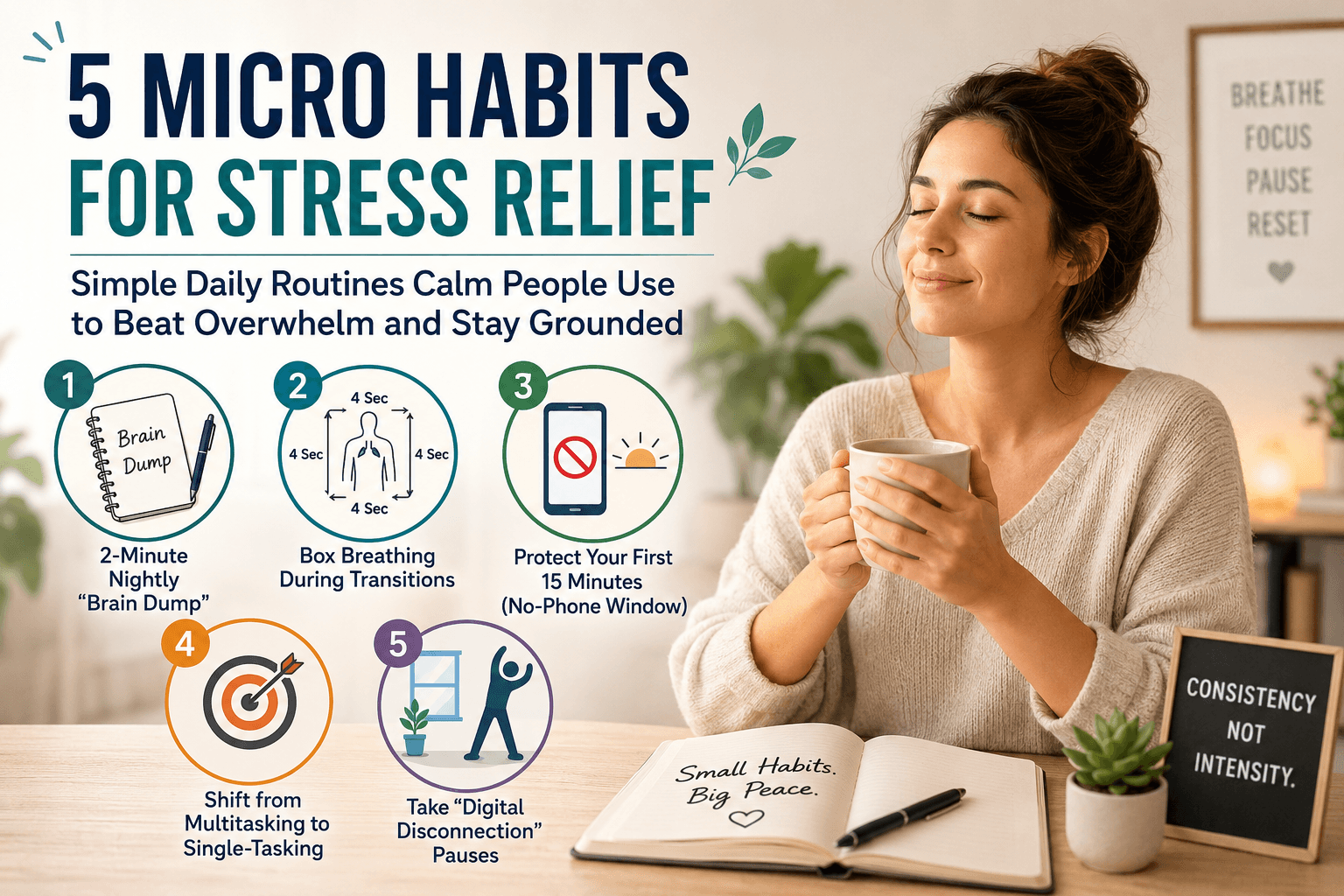
In today’s fast-paced digital world, feeling overwhelmed has almost become a daily norm. Between constant phone notifications, work deadlines, and life’s endless to-do lists, our brains are constantly running on overdrive. Yet, we all know that one person who always seems remarkably calm, collected, and unfazed by chaos. What is their secret? They rely on tiny daily routines, and practicing micro habits for stress relief is the easiest way for them to protect their mental energy without changing their entire schedule.
What is their secret? It is not that they have a problem-free life. Instead, they rely on small, actionable routines built into their day. If you want to protect your mental energy, practicing micro habits for stress relief is the easiest way to reset your nervous system without changing your entire schedule.
Here are 5 powerful micro habits for stress relief that calm people use to beat overwhelm and stay grounded every day.
“…Practicing micro habits for stress relief is the easiest way for them to protect their mental energy without changing their entire schedule. Developing a strong [growth mindset in business] or daily life starts with these exact tiny shifts.”
1. The 2-Minute Nightly “Brain Dump”
One of the biggest causes of mental fatigue and morning anxiety is an overactive mind. When you go to bed with unfinished tasks and random thoughts spinning in your head, your stress levels spike before you even wake up.
Calm people don’t carry their mental clutter into the next day. Every night before sleeping, spend just two minutes writing down everything that is bothering you or needs to be done tomorrow on a piece of paper. This simple act of “dumping” your thoughts signals your brain that it is safe to relax. If you are looking for actionable micro habits for stress relief, this quick routine is the perfect way to get deeper sleep and a calmer morning.
To get the most out of this nightly routine, here are a few simple steps to turn it into one of your highly effective micro habits for stress relief:
Close the Book and Say “Done”: Once you finish writing, physically close the notebook. This simple physical action acts as a powerful psychological cue, telling your mind that the day is officially over and it is safe to sleep.
Keep a Dedicated Notebook by Your Bed: Do not use a phone app for this exercise, as screen light can disrupt your melatonin (sleep hormone) levels. Use a physical pen and notepad dedicated solely to your nightly thoughts.
Write Without Editing: Don’t worry about neat handwriting, grammar, or making sense. Just write down whatever pops up—whether it’s a pending work email, a chore for tomorrow, or a random worry. The goal is to get it out of your head.
Create a “Tomorrow List”: If tomorrow’s to-do list is what’s keeping you awake, write down your top three priorities for the next day. This gives your brain a sense of control and prevents late-night mental loops.
2. Box Breathing During Daily Transitions
We often carry stress from one task straight into the next. If you jump directly from a stressful work email into a conversation with a family member, your brain never gets a chance to recover.
To fix this, use your transition moments—like closing your laptop, getting into your car, or waiting for water to boil—to practice quick micro habits for stress relief. Try box breathing for just 60 seconds:
- Inhale through your nose for 4 seconds.
- Hold your breath for 4 seconds.
- Exhale slowly through your mouth for 4 seconds.
- Hold empty for 4 seconds.
This instantly lowers your heart rate and clears cortisol (the stress hormone) from your body.
According to medical studies on [somatic breathing exercises], deep breathing cuts off the panic signal to your brain.”If you want to master this somatic technique, here are a few practical ways to embed it into your daily micro habits for stress relief:
The “4-Count” Mental Anchor: Counting to four during each step forces your brain to focus entirely on numbers and breathing, which completely cuts off the endless loop of stressful thoughts running in the background.
The Laptop Latch Reset: Every time you close your laptop at the end of a work session, do not instantly move to the next thing. Keep your hands on the closed laptop, close your eyes, and complete just two full rounds of box breathing.
The Steering Wheel Pause: When you get into your car to drive home, sit quietly for 60 seconds before turning on the engine or the radio. Use this micro-window to reset your nervous system from work mode to home mode.
Anchor it to Daily Chores: Use mundane moments—like waiting for your morning tea to brew or waiting for a website page to load—as automatic physical triggers to practice these breathing micro habits for stress relief.
3. Protect Your First 15 Minutes (No-Phone Window)
Most people grab their smartphones within seconds of waking up. Checking emails, social media, or news headlines first thing in the morning forces your brain into a state of comparison, urgency, and instant stress.
People who handle stress beautifully protect their peace early in the morning. When developing personal micro habits for stress relief, making it a strict rule to leave your phone away for the first 15 minutes after waking up is a game-changer. Use this time to drink a glass of water, look out the window, stretch, or simply breathe. Starting your day on your own terms sets a peaceful tone for the rest of the day.
If you want to protect your morning energy, here are a few actionable ways to turn this window into one of your favorite micro habits for stress relief:
The 3-Stretch Rule: Before leaving your bedroom, do three simple body stretches—like reaching for the sky or rolling your ankles. This shifts your focus into your physical body rather than the digital chaos of the internet.
Charge Your Phone Across the Room: Do not leave your phone on your nightstand or next to your pillow. By plugging it in across the room, you eliminate the physical temptation to reach for it the moment your alarm goes off.
The “Window View” Morning Routine: Spend just 60 seconds looking out the window at the morning sky or trees before looking at any digital screen. Natural light signals your brain to wake up gently, acting as one of the best biological micro habits for stress relief.
Hydrate Before You Scroll: Drink a full glass of water right after getting out of bed. Rehydrating your body first thing in the morning boots your metabolism and naturally lowers morning cortisol levels.
4. Shift from Multitasking to Single-Tasking
We often believe that answering an email while listening to a podcast and formatting a blog post makes us productive. In reality, juggling multiple things at once fractures your attention span and fills your brain with silent panic.
True focus is a form of natural stress relief. Trying to practice single-tasking is one of those underrated micro habits for stress relief that anyone can adopt. If you are writing, close all other browser tabs. If you are eating, just eat without scrolling through your phone. By giving 100% of your attention to one single thing, you stop your mind from feeling scattered and overwhelmed.
If you want to master single-tasking, here are a few simple ways to turn this into one of your daily micro habits for stress relief:
The 20-Minute Focus Block: Dedicate just 20 straight minutes to a single project without switching tasks. You will be amazed at how much faster you finish and how calm your brain feels afterward.
The One-Tab Rule: When working on a specific task, like writing content, close every single browser tab that isn’t directly related to what you are doing right now. This removes visual distraction instantly.
Monotasking Eating Habits: When having lunch or dinner, put your smartphone in another room. Focus entirely on the taste, texture, and experience of your food to give your brain a true mental break.
Batch Your Notifications: Instead of responding to messages the exact second they pop up, check your phone only at specific times (e.g., once every hour). This protects your focus and forms powerful micro habits for stress relief.
5. Take “Digital Disconnection” Pauses
Sitting in front of a screen for hours causes a hidden form of exhaustion known as digital fatigue. Your eyes get tired, your posture slumps, and your mental energy drains out completely without you even realizing it.
Every two hours, take a strict 3 to 5-minute break to completely step away from all electronic screens. Stand up, stretch your arms, look out the window at a distant object or a green plant, and let your mind drift without consuming any new information. Adding these tiny pockets of silence to your daily routine acts as one of the most effective micro habits for stress relief, preventing daily digital pressure from building up into a major mental breakdown.
If you don’t know what to do during these tiny screen breaks, here are a few simple ways to maximize this routine:
Hydration Break: Walk away from your desk to fetch a fresh glass of water. The physical movement combined with drinking water acts as a quick physical and mental circuit breaker.
Zero-Input Mind Drift: Do not pick up your phone to check notifications during this break. Let your brain sit in absolute boredom for 120 seconds so your nervous system can fully recalibrate. This is one of the easiest micro habits for stress relief you can practice at work.
Follow the 20-20-20 Rule: Every 20 minutes, look at something 20 feet away for at least 20 seconds. This instantly relaxes your eye muscles and stops screen-induced headaches.
The Physical Reset: Stand up immediately, roll your shoulders backward three times, and let your arms hang loose. Physical movement combined with deep breathing creates powerful micro habits for stress relief during a busy workday.
Conclusion: Start Small for Lasting Peace
You do not need to spend hours meditating or completely change your lifestyle to live a peaceful life. Real, lasting change happens through consistency, not intensity. By incorporating these simple micro habits for stress relief into your daily routine, you can easily protect your mental health and keep overwhelm at bay. Pick just one habit from this list today, practice it for a week, and watch your mental clarity transform.