1. The Introduction: The “Burnout” Reality
For the longest time, I was running on a treadmill that never stopped. I was spending 20+ hours a week just managing content—fighting with WordPress settings, staring at a blank cursor, and manually scheduling pins—rather than actually creating value. I was essentially an employee of my own blog.
Then, I shifted my mindset. I stopped acting like an operator and started acting like an architect. I realized that if I wanted to scale, I needed to implement AI content automation to build a system that worked while I slept. This transition didn’t just save me time; it allowed me to reclaim my sanity. Here is how you can stop being a prisoner to your content calendar and start building a high-leverage business through the power of AI content automation.
2. The “Before vs. After” Workflow
Transformation doesn’t happen overnight, but it starts the moment you admit that manual labor is the enemy of growth. If you are still handling every single task on your own, you aren’t scaling your business—you are merely an employee of your own blog.
Before (The “Employee” Era):
For months, I was my own bottleneck. My workflow was a recipe for burnout:
- Manual Keyword Research: I spent hours buried in spreadsheets, guessing search volume and intent. It was exhausting, tedious, and often inaccurate.
- Writer’s Block: I would stare at a blinking cursor for hours, waiting for inspiration that rarely arrived, which led to slow and inconsistent publishing.
- Design Fatigue: I was manually editing every single Pinterest pin in Canva. It was repetitive, soul-crushing work that kept me away from actual strategy.
- Scattered Social Posting: My social media presence was erratic and disorganized, resulting in zero real traffic. I was throwing mud at the wall to see what would stick.
After (The “Automated Ecosystem”):
Once I unlocked the power of AI content automation, the entire dynamic shifted. I stopped being the operator and started being the architect. Now, my blog runs like a well-oiled machine:
- Data-Driven Idea Generation: Instead of guessing what to write, I use AI content automation to map out content pillars in minutes, based on real-time search trends and audience data.
- Rapid Production: Drafting, outlining, and image creation now happen in a fraction of the time. The AI acts as my writing assistant, handling the heavy lifting so I can refine the unique insights that only I can provide.
- The Traffic Engine: My content doesn’t just sit there. It is automatically pushed to Pinterest and social channels through a streamlined system. This creates a passive traffic engine that drives clicks while I focus on high-level strategy and growth.
3. My AI Tech Stack (The “Affiliate Goldmine”)
To execute a successful AI content automation strategy, you need the right infrastructure. You can’t build a digital empire with manual tools; you need a “power stack” that acts as a virtual team, working 24/7. These tools are the foundation of my entire blogging ecosystem:
- ChatGPT (The Strategist): I don’t treat ChatGPT as just a writer; I treat it as my Chief Strategy Officer. It handles the heavy lifting of research, brainstorming, and outlining. By integrating ChatGPT into my AI content automation workflow, I’ve effectively eliminated the dreaded “blank page syndrome” that kills productivity for most founders.
- Rank Math (The SEO Guard): This is non-negotiable for blogging workflow automation. It tells me exactly what I need to fix to rank higher. Pro-Tip: Use the “Content AI” feature to see which keywords your competitors are using that you’ve missed.
- Canva (The Visual Engine): I use Canva’s bulk-create feature to design Pinterest pins in batches. Pro-Tip: Create one master template and use AI to generate your headline variations.
- Fiverr (The Virtual Workforce): While AI does 80% of the work, you might still need a human touch for advanced tech setups or custom coding. I use Fiverr Freelancers to source expert custom prompts, workflow automations, and premium brand assets whenever I want to scale faster without lifting a finger.
4. The 3-Step Automation Framework
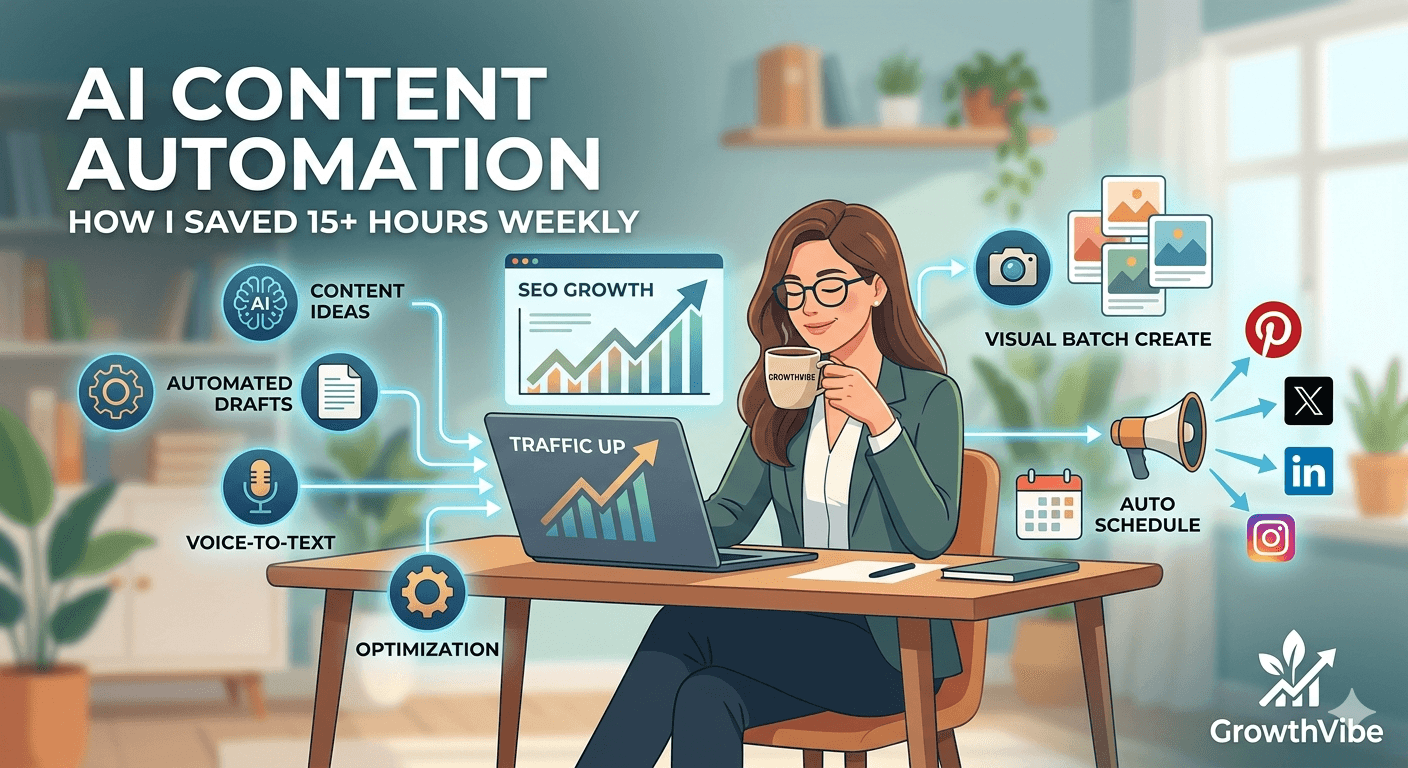
If you want to achieve professional results without the burnout, you need a system where your tools work in harmony. This is the exact AI content automation framework I use to turn a blank screen into a high-performing blog post:
- Step 1: Planning & Strategy (ChatGPT as your Researcher) Instead of guessing what to write, let the data guide you. I use ChatGPT to analyze current trends and search intent in my niche. I don’t just ask for “topics”; I ask it to identify the specific problems my audience is struggling with that competitors haven’t solved yet. This ensures that every piece of content I create is backed by strategy, not guesswork. This is the foundation of my AI content automation—starting with clarity so the production phase is effortless.
- Step 2: Content Production & Optimization (ChatGPT + Rank Math) I use ChatGPT to generate the “skeleton” and the rough draft of my article. However, I never publish raw AI text. I add the “human touch”—my personal stories, unique insights, and brand philosophy—to make it relatable.
- The SEO Guard: Once the draft is polished, I run it through Rank Math. This is non-negotiable. I use its “Content AI” to see exactly which keywords I need to include to outrank my competitors. Rank Math turns the AI-generated draft into a search-engine-optimized asset, ensuring my AI content automation workflow actually leads to traffic, not just more content on the web.
- Step 3: Visuals & Distribution (Canva as your Production House) Content is invisible without high-quality visuals. Rather than designing every Pinterest pin manually, I use Canva’s “Bulk Create” feature.
- The Workflow: I create one master, high-converting template. Then, I upload my article titles (which I pulled from my strategy phase), and Canva generates 10+ branded Pinterest pins in under a minute.
- The Scheduling: Once the images are ready, I schedule them to hit Pinterest and social platforms at peak times. Your content should be working for you 24/7, not the other way around. This automated distribution is the final, essential step in my AI content automation system.
5. What I Do With My Extra 15 Hours
Saving 15+ hours a week isn’t just about being “productive”—it’s about reclaiming your life as a founder. When you master AI content automation, you aren’t just saving minutes; you are buying back your potential.
Once the “busy work” is off my plate, I reinvest that reclaimed time into the high-leverage activities that actually move the needle:
- High-Leverage Deep Work: I no longer spend my mornings fighting with formatting or manual scheduling. Instead, I dedicate that deep work block to high-revenue tasks: analyzing my top-performing affiliate funnels, building new content pillars, and optimizing my overall SEO strategy. This shift from “doing the work” to “directing the work” is exactly how a solopreneur scales revenue without burning out.
- Authentic Digital Wellness: As a content creator, I know that creativity is a finite resource. By allowing my systems to handle the repetitive parts of blogging, I’ve given myself permission to step away from the screen entirely. I prioritize a genuine digital detox—disconnecting from the data and the dashboard to recharge. This distance is what allows me to come back with original insights and a fresh perspective that AI simply cannot replicate.My Wellness Secret: I highly recommend picking up paperbacks like Digital Minimalism or upgrading your workspace with ergonomic gear from Amazon to make your screen-free time truly restorative.
- From Maintenance to Long-term Vision: Before, I was stuck in the “maintenance trap”—constantly fixing typos, troubleshooting WordPress bugs, or obsessing over minor image alignment. Now, I’m looking at the horizon. With the time I’ve reclaimed through AI content automation, I’m focusing on the future: scaling my site traffic, identifying new niche opportunities, and building a brand that stands the test of time.
Essentially, I’ve moved from being a technician who manages a website, to an entrepreneur who grows a business. And the best part? It’s a sustainable rhythm that doesn’t feel like a constant grind.
6. Conclusion: A Call to Action
The difference between a struggling blogger and a successful founder is the system they build. AI content automation is not about replacing the human element—it’s about amplifying it.
Don’t just work harder; build smarter systems.
Ready to transform your own content workflow? Subscribe to the GrowthVibe newsletter below for more automation hacks, tech stack recommendations, and the exact strategies I use to scale my business.
1 thought on ““How I Automate My Content Creation Using AI (And Saved 15+ Hours a Week)””