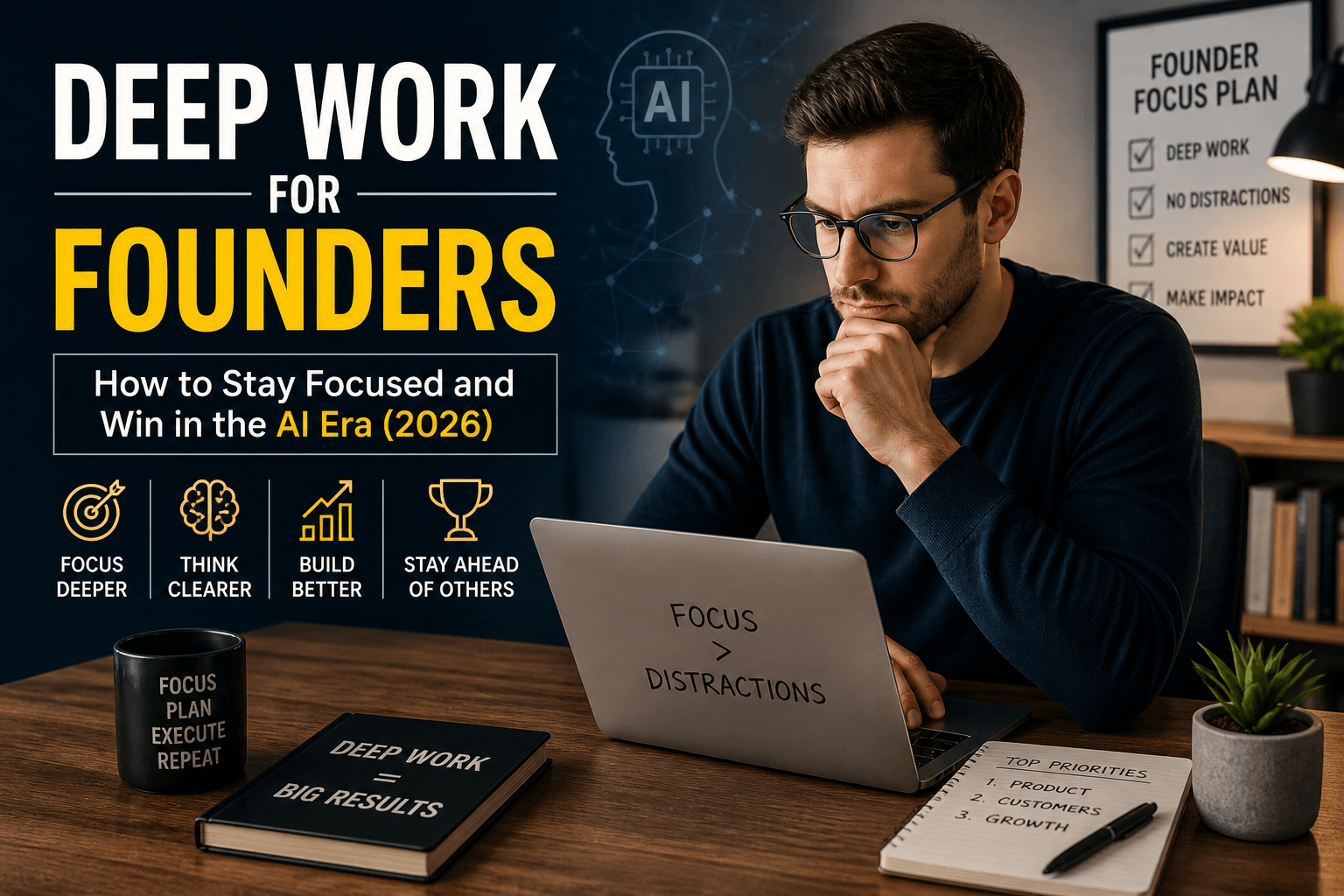
In 2026, deep work for founders is becoming the most important skill for building successful businesses. — it’s about working deeply. Deep work for founders is becoming the ultimate advantage in a world where AI tools are creating content, automating tasks, and speeding up execution. The real challenge is no longer access to resources… it’s focus.
Every day, you’re pulled in different directions — emails, meetings, notifications, and endless ideas. It feels productive, but in reality, it’s killing your ability to do the kind of work that actually grows a business. The truth is, while AI is getting faster, deep thinking is becoming rare — and that’s exactly where your advantage lies.
This is where deep work for founders becomes essential. Not just as a productivity hack, but as a competitive moat — something that separates founders who stay busy from those who actually build, scale, and win.
In this guide, you’ll learn how to reclaim your focus, cut through distractions, and use deep work for founders to outperform in an AI-dominated market. Because in a world where everyone has access to the same tools, the real edge belongs to those who can focus longer, think better, and execute smarter.
1. What Is Deep Work for Founders and Why It Matters in 2026
Deep work for founders means doing focused, distraction-free work on tasks that directly grow your business—without switching between emails, messages, or notifications. It’s about entering a state where you can think clearly, solve complex problems, and create high-value output that actually moves your startup forward.
In 2026, this skill has become even more important because AI tools are handling most of the routine work. That means the real value of a founder is shifting toward thinking, decision-making, and strategy rather than just execution.
🔹 Key Points
- Focus on high-impact work: Deep work for founders helps prioritize tasks that directly affect growth, revenue, and product development.
- AI handles the shallow tasks: Writing drafts, scheduling, data sorting, and automation are now done by AI, but deep work for founders ensures strategic thinking stays strong.”AI handles the shallow tasks: Writing drafts, scheduling, data sorting, and automation are now done by AI… If you haven’t automated these yet, you can [Find AI Automation Experts on Fiverr] to build these hands-free systems for you.”
- Reduces distractions: Deep work for founders removes constant interruptions like emails, Slack messages, and social media noise, helping you stay in control of your time.
- Improves decision-making: With deep work for founders, you think more clearly, leading to better business decisions and fewer costly mistakes.
- Increases productivity quality (not just quantity): Deep work for founders allows you to produce more meaningful results instead of just completing more tasks.
- Builds a competitive edge: Most founders stay busy but not focused—deep work for founders separates high-performing entrepreneurs from the rest.
- Essential in 2026 AI economy: As AI speeds up execution, deep work for founders becomes the rarest and most valuable skill.
“As AI speeds up execution, deep work for founders becomes the rarest and most valuable skill. To master this mental framework, we highly recommend reading the foundational book [Deep Work by Cal Newport on Amazon].”
2. Why Deep Work for Founders Is a Competitive Advantage in the AI Era
In the AI era, almost every founder has access to the same tools—AI writers, automation platforms, analytics dashboards, and productivity apps. This means execution is no longer the main differentiator. The real difference now comes from how well you can think, focus, and make decisions. That’s exactly where deep work for founders becomes a powerful competitive advantage.
When you can focus without distractions, you can solve harder problems faster, build better products, and make smarter strategic moves than competitors who are constantly distracted.
🔹 Key Points
- AI levels the playing field: Everyone can generate content, code, and marketing assets using AI, but not everyone can think deeply about what actually matters.
- Better strategy beats faster execution: Founders who practice deep work can design stronger business models and long-term strategies instead of just reacting to daily tasks.
- Higher-quality decisions: Deep focus helps reduce mental noise, leading to clearer thinking and fewer wrong business decisions.
- Faster problem-solving at a deeper level: Instead of surface-level fixes, deep work allows founders to identify root causes and build lasting solutions.
- Less time wasted on distractions: Most founders lose hours daily to notifications and multitasking—deep work helps reclaim that lost time.
- Creates rare skill in a noisy world: In 2026, focus is becoming rare. Founders who master deep work automatically stand out.
- Direct impact on growth and scaling: Deep work leads to better product development, stronger marketing strategy, and improved execution quality.
3. How AI Is Increasing Distractions for Modern Founders
In 2026, AI is supposed to make life easier for founders — and it does. But at the same time, it has also created a new problem: too many tools, too much information, and constant mental switching. Instead of staying focused on one important task, founders often end up jumping between AI apps, dashboards, and notifications all day.
This doesn’t just waste time — it breaks deep focus, which is essential for real business growth.
“Founders end up spending more time managing tools than actually thinking, planning, or building. If you want to completely reclaim your calendar, the smartest move is to [Hire a Top-Rated Virtual Assistant on Fiverr] to offload your daily administrative noise.”
🔹 Key Points
- Too many AI tools to manage: Founders now use multiple tools for writing, marketing, coding, analytics, and automation. Switching between them reduces focus and increases mental fatigue.
- Constant notifications and alerts: AI-powered apps send updates, suggestions, and insights all the time, making it hard to stay in uninterrupted work mode.
- Context switching overload: Moving from one task to another (e.g., strategy → email → AI tool → meeting) kills productivity and weakens deep thinking ability.
- Information overload: AI provides endless data, reports, and suggestions, but more information often leads to confusion instead of clarity.
- False sense of productivity: Using AI tools feels like progress, but in reality, it often replaces deep thinking with shallow task completion.
- More distractions, not fewer: Even though AI automates work, it also adds new layers of digital noise that compete for attention.
- Reduced deep work time: Founders end up spending more time managing tools than actually thinking, planning, or building.
4. The Core Principles of Deep Work for Founders
To actually benefit from deep work for founders, it’s not enough to just “try to focus.” You need clear principles that guide how you work every day. These principles help you cut distractions, protect your attention, and consistently do high-value work that grows your business.
In a world full of AI tools and constant notifications, these rules become even more important in 2026.
🔹 Key Points
- Work in distraction-free blocks: Set fixed time blocks (60–120 minutes) where you do only one important task without interruptions.
- Single-tasking over multitasking: Focus on one high-impact task at a time instead of switching between emails, tools, and meetings.
- Prioritize high-value work: Always start your deep work sessions with tasks that directly affect growth, revenue, or product development.
- Eliminate digital noise: Turn off notifications, close unnecessary tabs, and keep only essential tools open during deep work sessions.
- Schedule deep work like meetings: Treat focus time as non-negotiable calendar appointments, just like investor or client meetings.
- Work with intention, not reaction: Don’t let AI tools or messages decide your day—decide your priorities first, then execute deeply.
- Protect your peak energy hours: Use your most productive time of the day (morning or peak focus hours) for deep work only.
- Consistent routine matters: Deep work is not random—it works best when done daily or on a fixed schedule.
5. Practical Deep Work Strategies for Founders to Stay Focused
Practicing deep work for founders daily helps you stay ahead of competitors who are constantly distracted.
Knowing about deep work is one thing — but actually using it in real daily life is what makes the difference. For founders in 2026, the goal is not just to “work hard,” but to build systems that protect focus even in an AI-heavy, distraction-filled environment.
These practical strategies will help you consistently enter deep work mode and stay there longer.
🔹 Key Points
- Start with a daily deep work block: Set at least 1–2 hours every day where you work on your most important task without interruptions.
- Use the “one priority rule”: Before starting your day, identify one key task that will move your business forward and do it first in deep work mode.
- Turn off all distractions: Disable notifications, put your phone on silent, and close unnecessary tabs or apps during focus sessions.
- Use time batching: Group similar tasks (emails, meetings, admin work) into specific time slots so they don’t interrupt your deep work time.
- Apply the 90-minute focus rule: Work in focused cycles of 60–90 minutes followed by a short break to maintain mental energy.To keep yourself accountable without looking at your phone, you can use a [Visual Productivity Timer from Amazon].”
- Create a distraction-free environment: Work in a quiet space where interruptions are minimal and your brain can fully concentrate.
- Track your deep work hours: Measure how many hours you actually spend in deep focus each week to improve consistency.
- Avoid “AI over-dependence” during focus time: Don’t constantly switch to AI tools for every small decision—use your brain first, then tools.
6. How to Build a Deep Work Routine as a Founder
A strong deep work routine for founders is what turns focus from a random effort into a daily habit. In 2026, where AI tools and distractions are everywhere, having a fixed routine is what helps you stay consistent, productive, and ahead of competitors.
The goal is simple: train your mind to enter deep focus at the same time every day, just like a system.
🔹 Key Points
- Set a fixed deep work time: Choose a specific time each day (morning works best for most founders) and protect it like a non-negotiable meeting.
- Start small, then increase: Begin with 60 minutes of deep work daily and gradually extend it to 2–3 hours as your focus improves.
- Create a pre-work ritual: Do the same routine before every session (e.g., clear desk, turn off phone, review one goal) to signal your brain it’s focus time.
- Plan your top task in advance: Decide the night before what you will work on so you don’t waste time thinking during your session.
- Use a consistent workspace: Work in the same place whenever possible to build a mental “focus trigger.”
- Limit decision-making during deep work: Avoid deciding what to do next while working—everything should already be planned.
- End with a quick review: After each session, note what you completed and what needs improvement for the next day.
- Protect your routine from interruptions: Treat deep work as sacred time—don’t allow meetings or small tasks to break it.
7. Final Thoughts: Winning in an AI World with Deep Work for Founders
In 2026, the biggest advantage a founder can have is not access to tools or AI — it is the ability to stay focused in a distracted world. While AI continues to automate tasks and speed up execution, it also increases noise, distractions, and information overload.
This is why deep work for founders is no longer optional — it is a survival skill for building and scaling a successful business.
Founders who master deep work can think more clearly, make better decisions, and create higher-value work in less time. On the other hand, those who stay reactive and distracted will struggle to keep up, even with the best tools.
The real truth is simple:
AI can increase speed, but only deep work can increase direction.
If you can protect your focus, design your routine, and consistently enter deep work mode, you gain something most founders don’t have — clarity in chaos and a real competitive edge.
That is why mastering deep work for founders is the real edge in an AI-driven world.
In the end, success in the AI era won’t belong to the busiest founders. It will belong to the ones who can think deeply, work quietly, and execute with intention.